TL;DR
Most teams calling themselves AI-native are at L1. It's the same scattered go-to-market, just typing faster. The AI Maturity Framework has six rungs: Manual, Assisted, Integrated, Owned, Connected, Autonomous. Each rung has a specific wall above it. No context graph, no named owners, no command centre, no trust in long-horizon loops. Locate your rung honestly, find the wall directly above you, and build the one thing that clears it. Adding more agents is the generic wrong move at every level.
Microsoft removed Core partner rebates as part of the FY27 partner strategy, taking out a large portion of the bottom-line funding partners used for demand gen, events, and outbound marketing. Stagnant growth isn't an option anymore, which is exactly why streamlining GTM matters more in FY27 than it did last year. The money that used to subsidise the pipeline has to come out of a more efficient system instead.
I've spoken with over 1,000 UK MSPs. Some use AI in ways others haven't realised are possible. Others have automations that were meant to save time and support growth, and instead quietly damage the brand. Almost none have a 360 GTM system. We call that system the GTM Engine.
1000+
UK MSPs spoken with while building this framework
6
rungs on the ladder, from fully manual to fully autonomous
L1
where most teams actually sit, including the ones calling themselves AI-native
What Is a GTM Engine?
It's one central machine that runs your marketing and sales. Agents and humans wired together, pointed at a number at each stage of the funnel. Reach at the top, booked calls in the middle, closed deals at the bottom. One system, one direction.
Most companies have the pieces. A writer here, an outbound tool there, a CRM nobody fills in. All of it scattered, siloed, and not talking to each other. The engine is what you get when you wire those pieces into one thing that can actually move.
Below is a six-step ladder. For each rung: a definition, the risks, and how to move to the next level.
L0: Manual
This is John right now. Five staff, a couple of hundred devices under management, a few dozen clients who've stuck with him for years because he picks up the phone. Growth comes from referrals and the fact that John is good in a room. There's a LinkedIn page that posts when someone remembers. There was a webinar last spring that went quite well, apparently.
And there's revenue. Steady, dependable revenue. That's the part that fools people. They think because the invoices go out, there's a system underneath them.
Ask John what closed his three best deals last quarter and you get a shrug. A bit of everything, probably word of mouth. One was £22k, one was £9k, one was £31k, and the source field in the CRM is empty on all three. The CRM has data in it the way a junk drawer has stuff in it. There's a spreadsheet somewhere with renewal dates, mostly right. Nothing is captured cleanly enough to learn from, so nothing can be repeated on purpose.
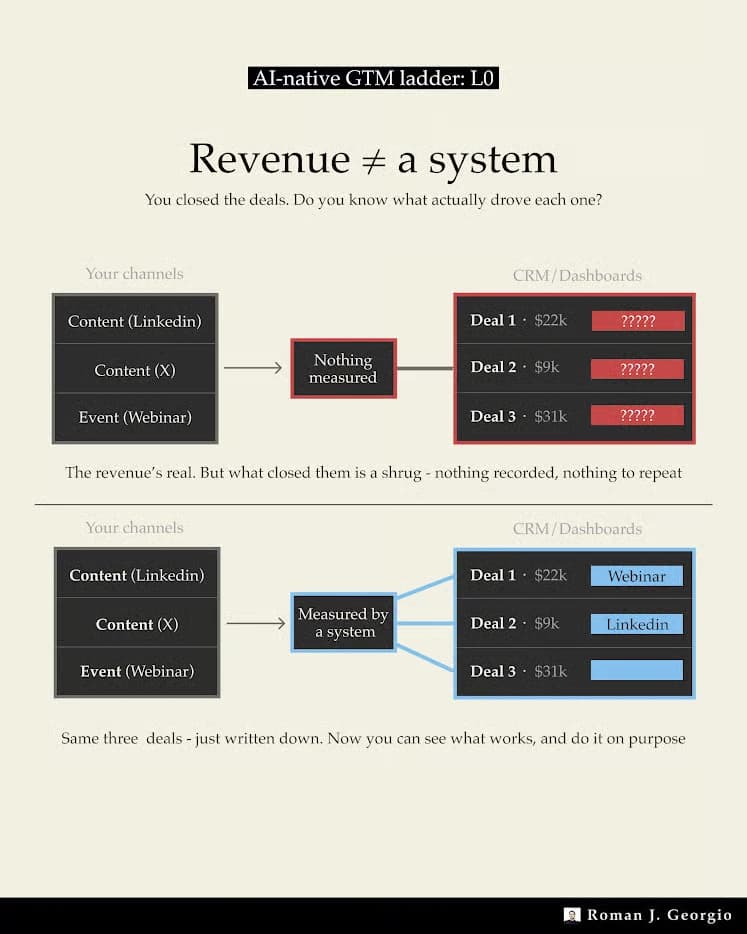
The play: there's nothing to build yet at this stage. The one useful thing John can do is start writing down what actually happens. Every deal, every source, every conversation that led somewhere, recorded properly and consistently, so that later, when the tools show up, there's something real for them to plug into.
L1: Assisted
The next rung is simple: the team starts using AI to do the individual jobs faster. John drafts LinkedIn posts in ChatGPT instead of staring at a blank box for forty minutes. Someone starts summarising discovery calls into follow-up emails instead of scrolling back through their notes. Proposals write themselves from a rough brief, so quoting takes an afternoon instead of two days.
Everyone on the team is suddenly quicker at their own bit. It feels like progress, and it is progress. But most MSPs stop right here and quietly start calling themselves "AI-native." That's the trap. It's the same scattered go-to-market, just typing faster.
There's a sharper failure mode too, and it's the one that actually costs money. John buys an AI SDR and points it at everyone. The whole list, the whole subreddit, the entire filtered LinkedIn search. It sends hundreds of confident, plausible, generic messages to people who have no reason to care. Eleven people reached, one of them vaguely relevant, and a brand that now reads as spam to the other ten. Compare that to John doing it himself: three messages, all three land, and it doesn't scale past Tuesday. The version that works is targeted AI. Dozens reached, almost all of them relevant, but only because someone understood the process before automating it.
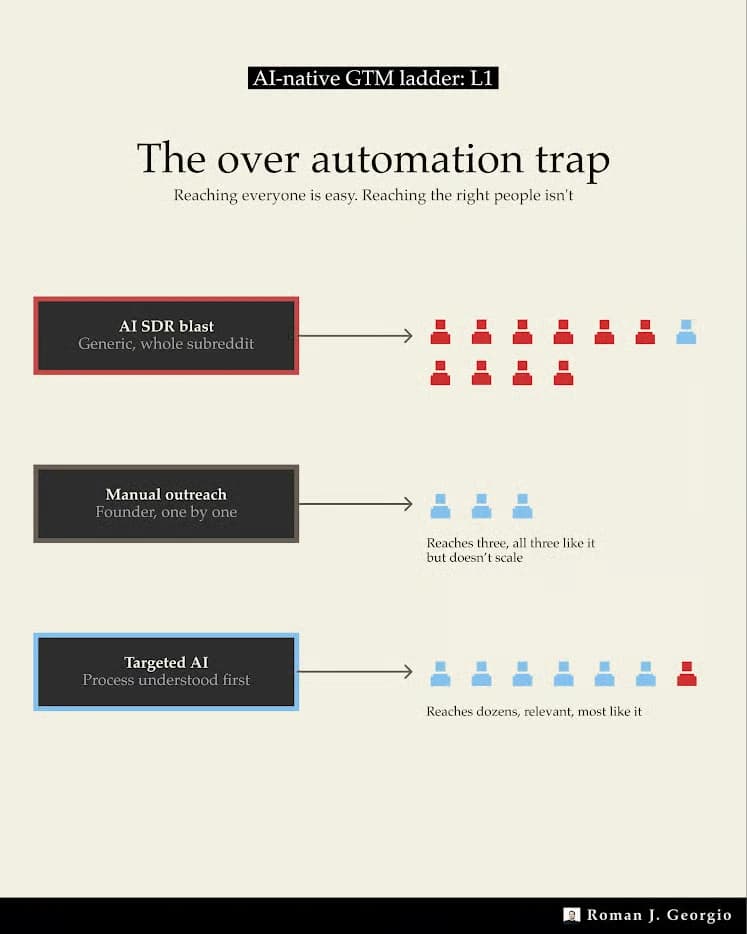
Reach is not the hard part. Reach has never been the hard part. Trust, once it slips like that, doesn't come back with an apology email.
The play: experimentation with a leash on it. Find out what the tools are actually reliable at, which is usually drafting, summarising, research and first-pass copy. Then find out what they're not to be trusted with unsupervised yet. When something genuinely works, John doesn't let it stay a personal habit one person uses. He turns it into how the team does that job.
L2: Integrated
Now the AI tools start getting properly wired into the actual stack. The CRM, the website, the call recorder, LinkedIn. No more living in a browser tab next to the real systems. One workflow becomes measurable end to end. John picks inbound: every enquiry now flows through one connected path, form fill to enrichment to routed owner to logged outcome, visible on a dashboard he actually opens.
It's still one workflow. Outbound is still ad hoc. Content is still whoever has a spare hour. But the one thing that's wired is genuinely wired.
And here's the first real wall. To get past doing one workflow at a time, John needs his data to actually be AI-ready. Not scattered across a CRM, a website analytics tool, a folder of call notes and someone's memory, but one connected picture: every account, every touchpoint, every conversation, every deal outcome, in a shape the AI tools can read and reason over. Without that, every new agent he adds re-learns the business from scratch, and still guesses.
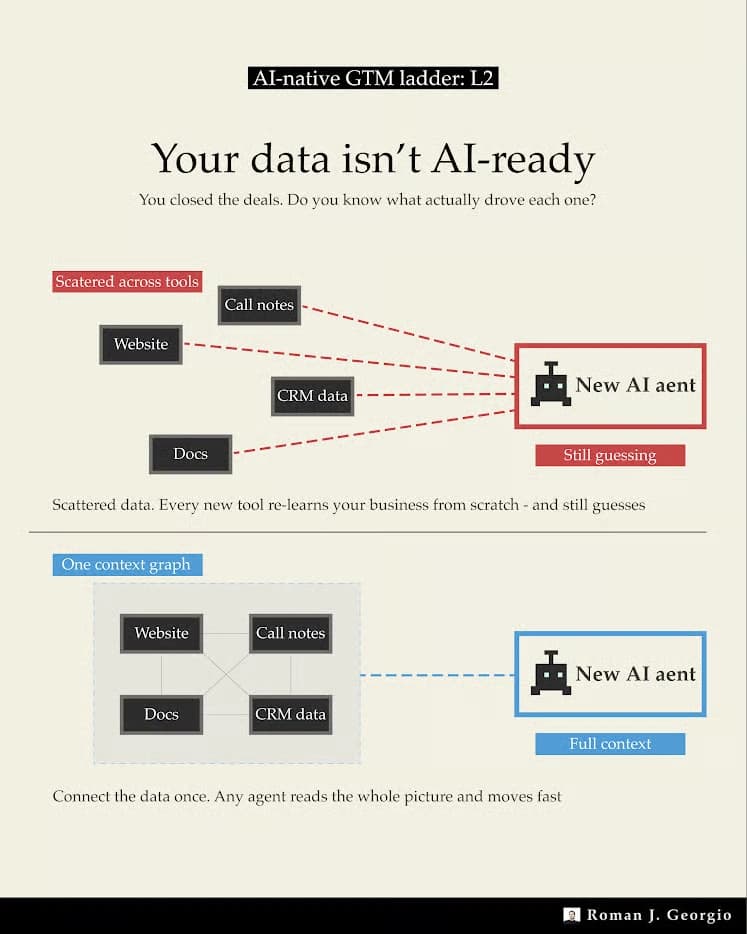
The play: pick one workflow and make it completely real before touching the next. Trying to wire everything at once means nothing gets properly wired. But once one is done, get the underlying data clean and connected, because that's what everything above this rung is going to be built on.
L3: Owned
With the data underneath them finally solid, John puts a name on every function. Content has an owner. Outbound has an owner. Paid and website have an owner. Events have an owner. Renewals and account growth have an owner. Each one running a stack of specialist agents underneath them, pointed at one number they're accountable for.
This is where the augmentation really shows itself. Take content. An agent can't be the person with a point of view, the one who's sat in three hundred client meetings and knows which objection actually stops a deal. But it can research the topic, draft the post, cut it into five formats, watch what every competitor in the category published this week, and have all of it sitting ready before the owner's first coffee. The owner brings the judgement. The agents do the thousand hours of work around it.
There's a failure mode John's team hits here too, and it's the quiet one. An owner switches the agents on, sees good output for a fortnight, and stops checking. Nobody reviews anything. Three months later the posts have drifted into generic mush, the outbound copy is making claims the company can't quite back, and the whole thing reads like nobody wrote it, because nobody did. Owned still has to mean owned. The agents doing the work doesn't mean nobody's watching the work.
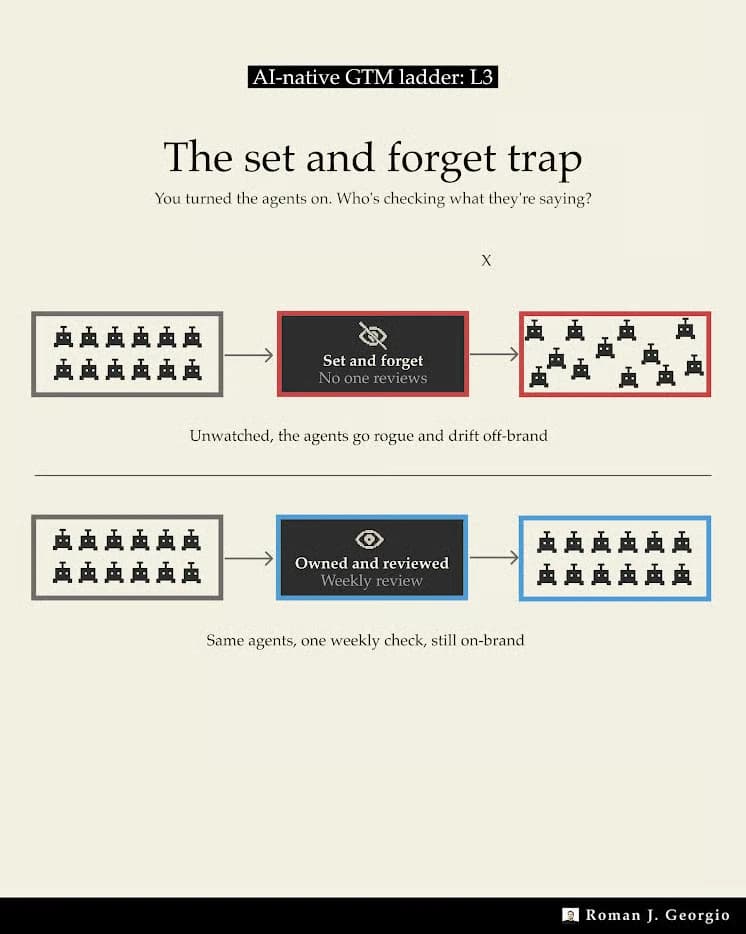
Then the next wall appears. Five owned functions, each running well on its own, is five good little engines and no single place to see across all of them. To get past this, John needs one command centre: a single report where every function's state, every agent, every metric, is visible and steerable together, instead of five different dashboards and a gut feeling.
The play: give every function that matters a single owner accountable for a single number. Reply rate, booked calls, pipeline coverage, renewal rate. Not something too far downstream like overall profit, which is impossible to actually steer by. And decide on purpose which moments stay human. Protect those deliberately.
L4: Connected
Once everything is owned, the functions start triggering each other without someone in the middle relaying messages. An objection that keeps surfacing on sales calls automatically becomes next week's content brief, and the post that comes out of it books more calls. A page that suddenly starts converting reshapes the outbound copy pointing at it. An account's renewal risk score updates the moment their engagement drops, not at the quarterly review. An event registration list quietly reprioritises who outbound touches first.
Right now, in most businesses, those channels are locked boxes. The killer objection a rep heard on Tuesday never reaches the person writing content on Thursday. Connected is what happens when it does, automatically, every time.
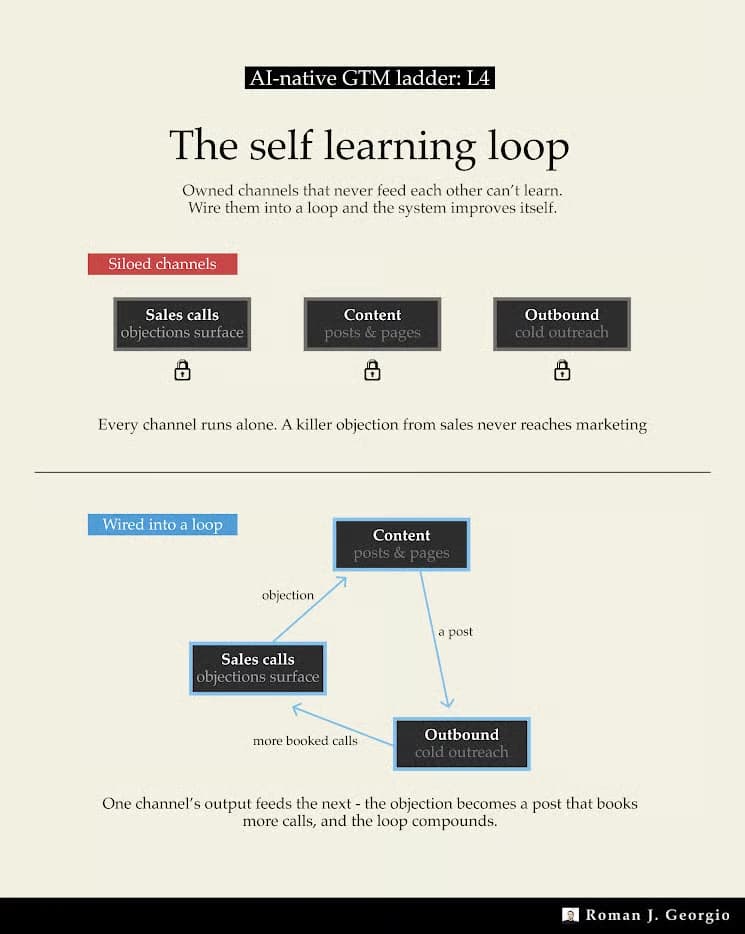
This is the level people picture when they say "AI-native." Most who claim it are honestly still at L3 with a nice dashboard.
The last wall is the hardest one. The short loops are easy: objection in, post out, booked call, same fortnight. To get past this, John's team has to trust the long loops, the ones that only prove themselves out over months. A positioning shift that won't show up in pipeline until two quarters from now. An account health score that predicts churn three quarters out and quietly adjusts strategy today. Trusting a system over that kind of horizon, without checking every single step along the way, is the actual hard part.
The play: don't connect what isn't owned properly yet. Wiring five messy functions together just gets you a faster mess. Start with the obvious short loops, prove they hold up, then earn the trust for the longer ones. And someone still looks at the whole system weekly. Connected never means unattended.
L5: Autonomous
John isn't here yet. Nobody John knows is fully here. But it's worth saying what it looks like, because it's what the whole climb has been pointing at.
Today the shape is linear and John is in every step of it: he decides what to research, he drafts, he sends, he reviews. The tools help, but he's the one moving the work along. At L5 that reverses. The system sees what needs to happen across the entire go-to-market and routes the work accordingly, to an agent or to a person, whichever the moment actually calls for. It drafts the posts, writes the outbound, builds the landing pages, books the follow-ups, closes the loop on everything that doesn't need a human at all. Then it surfaces three items and asks John to review them.
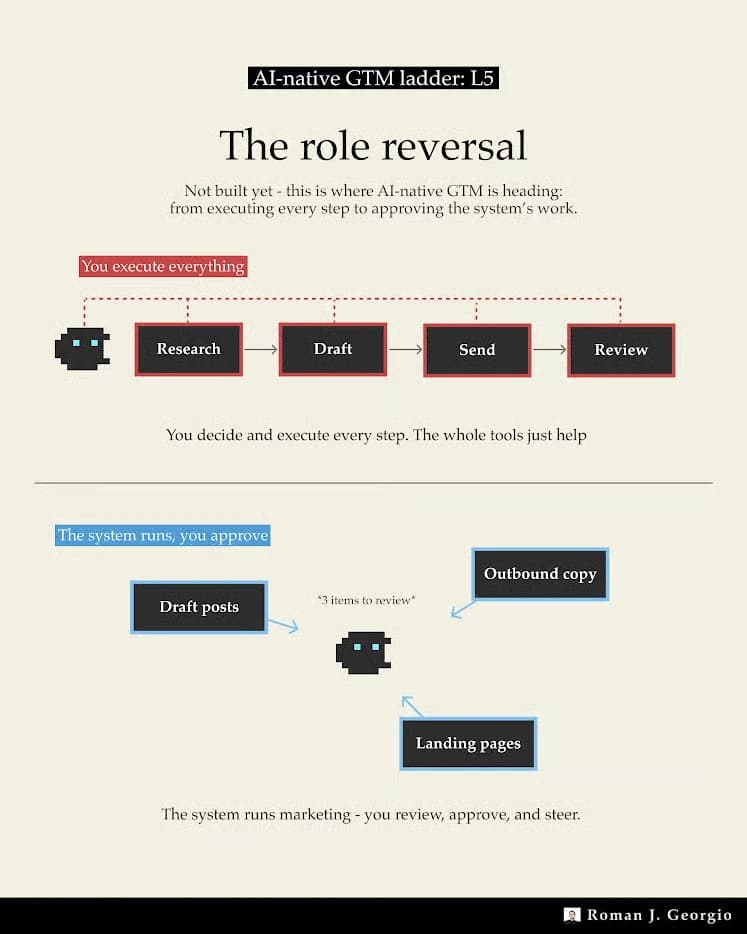
And it pulls John and his senior team into only the moments that genuinely need judgment: the enterprise client renegotiating terms, the deal serious enough to need a person on the phone within the hour, the call on whether to take on a client whose risk profile doesn't quite fit. The job stops being "do every step" and becomes "steer the business, review the work, step in exactly where it matters."
The team never disappears at this level. If anything they matter more. Concentrated, pulled out of the noise and put squarely into the handful of places where only human judgement can approve.
The play: don't kid yourself about being here early. Spend as much care deciding what gets routed to a person as what gets handed to an agent. And be a little sceptical of any MSP telling you they've already arrived. Most of the time, they're at L3 with a good dashboard.
Using This On Yourself
Locate the rung honestly. Most real teams are at L1, or one process limping toward L2.
Then find the wall directly above you, not three rungs up:
| Transition | The wall |
|---|---|
| L1 → L2 | No context graph |
| L2 → L3 | No named owners per process |
| L3 → L4 | No command centre |
| L4 → L5 | No trust in long-horizon loops |
Build the one thing that clears that wall.
Warning
Not "add more agents." That's the generic wrong move at every level, and it will lead to review debt, meaning more output than anyone on your team has capacity to check.
Protect your human edges on purpose. Decide, explicitly, which step needs a person, and design the rest of the system around leaving that step alone.
Talk to a GTM engineer
Bring your market and we'll show you the accounts heating up in it right now, and what an engine built around them looks like for your team.
Book a call